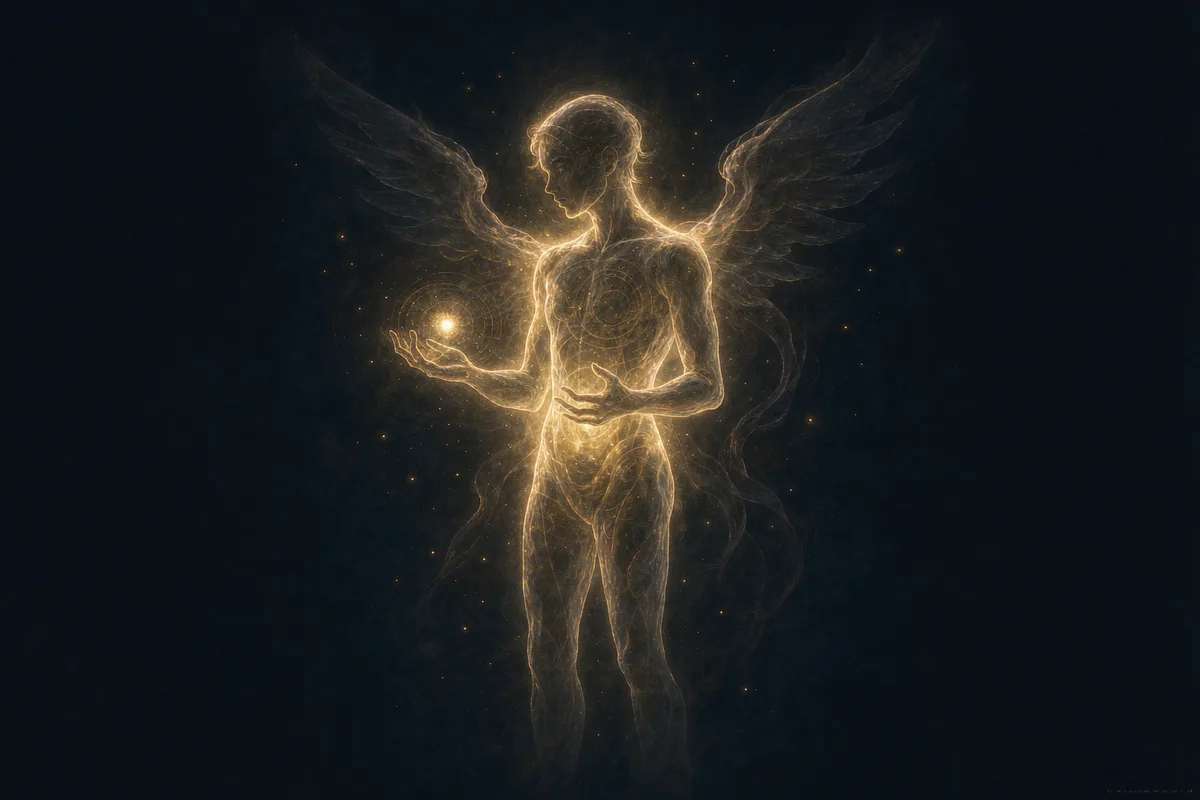
In the esoteric tradition of Europe, the guardian spirit is the personified cosmic energy assigned to every person at birth. From the Egyptian "Ka" through the Greek "Daimon" to the Christian "guardian angel", very different cultures share a strikingly similar idea of the guardian spirit: a wise being that transcends the material world and accompanies and steers the soul's journey.
The origin and history of the guardian spirit
The concept of the guardian spirit reaches back to the earliest days of human civilisation. In ancient Egypt it was believed that every person received a "Ka" at birth — the embodiment of the life force, which continues to exist after death. The Greek philosopher Socrates often spoke of his "daimon" — an inner voice of guidance that warned him when he was about to make a wrong decision.
In Christian belief the concept of the guardian angel is deeply rooted. The Catholic Church has even dedicated a feast day to it — the Feast of the Guardian Angels on 2 October — in honour of these holy protectors. The medieval theologian Thomas Aquinas discussed the hierarchy of the angels at length in his "Summa Theologica", in which the guardian angel is held to be the spirit closest to the human being.
Types of guardian spirit
In modern spiritual tradition, guardian spirits are usually divided into the following types:
- Animal guardian spirits: they appear in animal form and represent your inner instinctive powers and character traits. The wolf, for instance, stands for loyalty and intuition, the eagle for far-sightedness and freedom.
- Ancestral guardian spirits: the presence of your ancestors in the spiritual world. They preserve the wisdom and memories of your family and can give you orientation in decisive moments.
- Angel guardian spirits: beings of light from higher dimensions that have never lived a human life and can therefore offer a perspective beyond human limits.
- Ascended masters: beings who were once human and have developed to a higher level of consciousness, such as Jesus, Buddha or Mother Mary. They can help several souls at the same time.
- Nature elementals: beings connected with particular natural elements, such as tree spirits, water spirits or wind spirits — especially suited to people who wish to work with the energy of nature.
How to recognise your guardian spirit
Your guardian spirit is constantly trying to communicate with you — perhaps you have simply not yet learned to listen. Here are some common signs of that communication:
- Recurring animal images — in a dream, in everyday life or during meditation
- Sudden intuitions or the "inner voice" — especially before important decisions
- Synchronicities — the same numbers, symbols or particular songs again and again
- Changes in temperature — sudden warmth or coolness, above all around the shoulders or the crown of the head
- Feathers, coins or other small objects that appear "out of nowhere"
A meditation to connect with your guardian spirit
Here is a simple meditation exercise that helps you build a first connection with your guardian spirit:
Step 1: Prepare the room
Find a quiet place and light a white candle (it stands for pure energy). You may play soft music or nature sounds. Make sure you will not be disturbed for the next 15–20 minutes.
Step 2: Breathe and relax
Close your eyes and take five long, deep breaths. With each inhalation imagine golden light flowing into your body, and with each exhalation let go of all tension and worry.
Step 3: Set the intention
Say inwardly: "I invite my guardian spirit to connect with me in this moment. With love and gratitude I ask for your guidance and your protection."
Step 4: Visualisation
Imagine that you are standing in a beautiful natural setting — a forest, by the sea or in the mountains. Feel the sunlight (or moonlight) resting on you. Then invite your guardian spirit to appear before you. Do not decide in advance what it looks like — let your intuition lead you.
Step 5: Receive the message
When you sense the presence of your guardian spirit, you can ask a simple question, for example: "What is your name?" or "What would you like to tell me?" Pay attention to the first image, word or feeling that comes to mind — that is your guardian spirit's answer.
Step 6: Gratitude and closing
Thank your guardian spirit for its presence and promise to deepen the connection. Breathe deeply three times, open your eyes slowly and write down what you experienced.
The connection with your guardian spirit in everyday life
Meditation is only one way of connecting with your guardian spirit. In daily life you can strengthen the connection in the following ways:
- Take 30 seconds every morning when you wake up to thank your guardian spirit for its company
- Actively ask your guardian spirit for a sign in moments of helplessness
- Keep a "journal of synchronicities" in which you record all apparent coincidences
- Regularly use tarot cards or oracle cards to communicate with your guardian spirit
- Perform a ritual for your guardian spirit at full moon or new moon
Frequently asked questions
What is a guardian spirit?
A guardian spirit is, in the European esoteric tradition, the personified energy assigned to a person at birth and said to accompany them through life. It is not a separate being that intervenes in events; in most accounts it is closer to a constant inner presence, the voice that speaks before you have finished thinking. The word covers several older figures at once: the Egyptian ka, the Greek daimon, and the guardian angel of Christian tradition.
What does the phrase guardian spirit mean?
The phrase joins two ideas. Guardian points to protection and attention, something that watches over rather than directs. Spirit points to what is not physical: an intelligence without a body. Put together, the term describes an attentive non-physical presence rather than a fortune-teller. That distinction matters, because a guardian spirit is traditionally described as accompanying your decisions, not making them.
How do I find my guardian spirit?
There is no procedure that produces a result on demand, and any source that promises one should be read with caution. What the tradition offers is a way of paying attention. First, notice repetition: an animal, a symbol or a phrase that keeps returning. Second, notice the moment before thinking, the intuition that arrives ahead of your reasoning. Third, make room for stillness, which is what the meditation above is for. Ten quiet minutes a day is enough to start.
Is a guardian spirit the same as a spirit guide?
No. They overlap but are not identical. A guardian spirit is, in this tradition, assigned at birth: you do not choose it and it does not change. A spirit guide is a broader category, a teacher, an ancestor, an animal presence or a figure from a tradition, and a person may work with different guides at different times. The guardian spirit is the constant; guides are the ones that come and go.
Is a guardian spirit always an animal?
No. Animal form is one of several types, the wolf for loyalty and intuition, the eagle for far-sightedness, but the same tradition also describes ancestral guardian spirits and human figures. Which form appears is usually read as a reflection of what the person needs to develop, not as a fixed rank or a better and worse category.
How do I know it is not just my imagination?
You cannot know, and the tradition does not ask you to. There is no test that separates an inner presence from a well-developed imagination, and anyone who offers one is overstating what can be verified. The more useful question is different: does paying attention to this change how you act? If noticing a recurring symbol makes you pause before a decision, the practice is doing its work, whether or not the presence is real in an external sense.
Can I have more than one guardian spirit?
Traditions differ and this page does not settle the question. Some accounts describe a single guardian assigned at birth; others describe a primary presence accompanied by secondary ones, ancestral, animal or seasonal. What is consistent across accounts is the framing: these are presences to reflect with, not authorities to obey.
 The Complete Handbook of Angel Numbers: The Meanings of 111 to 999
 How to Recognise the Signs of Your Guardian Angel
 Tarot for Beginners: The Complete Guide to the Major and Minor Arcana