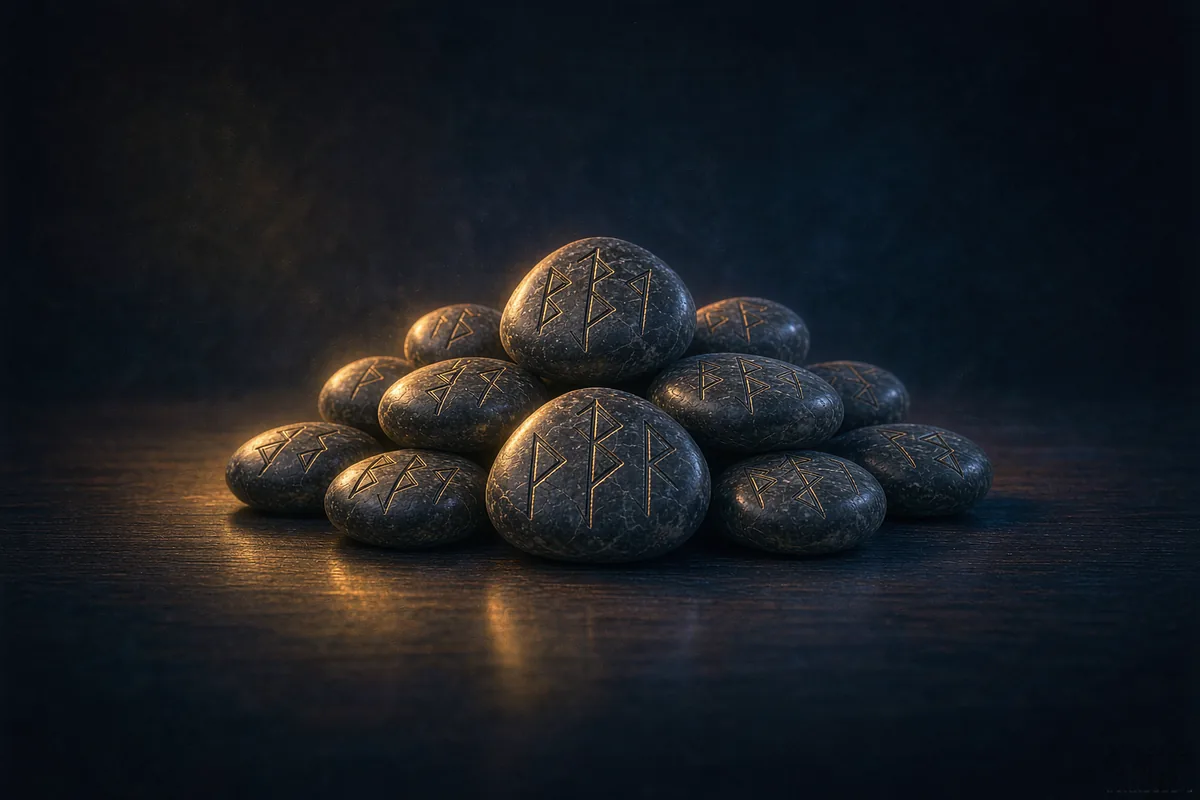
The runes are an alphabet that the ancient Germanic peoples used; it arose in northern Europe around the second century AD. Yet runes are far more than written characters — in Norse mythology and tradition every rune carries within it a powerful magical force and a piece of cosmic wisdom. The old Scandinavians believed that the runes were sacred knowledge which Odin won through an immense sacrifice, when he hung on the world tree Yggdrasil for nine days and nine nights.
The mythical origin of the runes
According to the Poetic Edda, Odin wounded himself with his own spear and hung head downwards on the world tree in order to gain wisdom. During those nine days of suffering he stared into the abyss beneath him and at last saw the runes rise up out of the darkness. This sacrifice gave the runes a power that goes beyond ordinary written characters — they became the bridge between human will and the laws of the cosmos.
"I know that I hung on the windy tree for nine long nights, wounded with the spear, dedicated to Odin, myself to myself." — from the Hávamál (the words of Odin)
The Elder Futhark: 24 sacred runes
The oldest runic alphabet is called the "Elder Futhark" and comprises 24 runes, divided into three "ættir", each with eight characters:
First ætt: Freya's ætt — connected with creation, the material world and fundamental energies
- ᚠ Fehu: wealth, prosperity, a new beginning
- ᚢ Uruz: strength, endurance, wild energy
- ᚦ Thurisaz: protection, conflict, catalyst
- ᚨ Ansuz: communication, wisdom, divine breath
- ᚱ Raido: journey, movement, the wheel of fate
- ᚲ Kenaz: knowledge, creativity, flame
- ᚷ Gebo: gift, exchange, partnership
- ᚹ Wunjo: joy, harmony, the fulfilment of wishes
Second ætt: Hagal's ætt — connected with transformation, challenges and mental trials
- ᚺ Hagalaz: destruction, purification, higher force
- ᚾ Nauthiz: need, restriction, patience
- ᛁ Isa: standstill, introspection, frozen potential
- ᛃ Jera: harvest, cycles, cause and effect
- ᛇ Eihwaz: endurance, death and rebirth, the world tree
- ᛈ Perthro: the well of fate, secret, cause and effect
- ᛉ Algiz: protection, the higher self, awakening
- ᛊ Sowilo: sun, success, victory
Third ætt: Tyr's ætt — connected with higher consciousness, spiritual growth and destiny
- ᛏ Tiwaz: justice, leadership, sacrifice
- ᛒ Berkano: birth, motherhood, growth
- ᛖ Ehwaz: trust, partnership, movement
- ᛗ Mannaz: humanity, community, the self
- ᛚ Laguz: water, intuition, flow
- ᛜ Ingwaz: potential, inner growth, seed
- ᛞ Dagaz: breakthrough, transformation, dawn
- ᛟ Othala: inheritance, home, roots
The practice of rune divination
The most common form of rune divination is "drawing a rune" — the rune stones are placed in a bag, and once you have settled yourself you draw one or several runes. Unlike tarot, runes work more directly and more primitively; each rune is like a seed that contains many meanings and has to be interpreted according to the present situation.
Single-rune draw: suited to daily guidance; it answers questions such as "What is the energy today?" or "What is the core of this question?"
Three-rune spread: similar to three tarot cards, representing the root of the question, the present situation and the recommended action.
Celtic Cross with runes: uses 10 runes for an in-depth analysis of complex life themes.
 The Daily Rune: Guiding Your Day with Rune Stones
 Making Your Own Rune Amulet: Step by Step
 A Short History of European Mysticism: From Alchemy to the New Age Movement